Showing posts with label Applied Science (see Intro). Show all posts

Thursday, December 14, 2006

predicting change or predicting absolute values


we define
forecasting as testing model on data not utilised to develop model and
predicting as testing model on data which is obtained from observing the system in a future time.

in that case, the above graph shows a prediction of algal biomass one hour ahead of time. the system was developed to emulate the natural function relating (water quality parameters) and (chlorophyll one hour ahead in time) as observed in a period of 388 hrs, which is around 16 days and 4 hrs. it is validated over the next (approximately) 16 days and is tested over the next 32 days. The figure below summarises this.

what we find is that we follow trends well, but base value is lost. which suggests that we might as well try to predict 'change' in algal biomass. we could experiment by defining change as a vector value - with a magnitude and a direction.

One reason why this idea has not been persued yet is also because the above graph collapses to almost gibberish when time gap is increased further - see below.

To be fair, the above graph is not ALWAYS the case, the exact graph changes often enough - in one case it was tracing ok for a while and then turned into a straight line. but in all cases the regression coeff drops to something like .3 and the graph whatever be their flaw they all have this in common that they ARE NOT ACCURATE!

Friday, December 01, 2006

Enivironmental Modelling and Monitoring - Sites

1. UCL DEPARTMENT OF GEOGRAPHY
ENVIRONMENTAL MONITORING AND MODELLING GROUP

Well designed site.
Has a list of
- publications
- researcher contacts
- PhD projects - ongoing and recently finished.

2. School of GeoSciences, Institute of Geography, Science and Engineering at The University of Edinburgh
This site did not impress.
firstly, they a lot about GIS (Geographic Infomation Systems) - somehow the context is not clear. is the term being used as a synonym of all geo monitoring techniques or what?
secondly, the site seems to have been last updated in 2000 (either that or they havent published anything since)

Environmental Fellowship Program
Monitoring and Modeling
University of Massachussettes Amhersts

This is a work group, consisting people from different departments


work in process

Friday, November 24, 2006

Physical Indicators and their influence

From Daly and Smith, 2003
Influence of temperature
1. may constrain the maximum growth rate of phytoplankton
2. suggested that temperature, rather than food limitation, drive zooplankton production in temperate coastal regions
3. may be an important determinant of trophic structure
4. effect of temperature may be more important as a covariate with other factors than as a direct control of productivity.
...influence of temperature on marine productivity remains equivocal.

Hydrodynamic processe are believed to control primary productivity in the ocean by governing irradiance and nutrients. (see below, keep in mind that marine ecology is being discussed - and therefore processes are very different than at an estuarine systm)
... the scale at which vertical mixing is a function of wind velocity, duration of wind event, and fetch, and is generally confined to the upper 100m of the ocean.

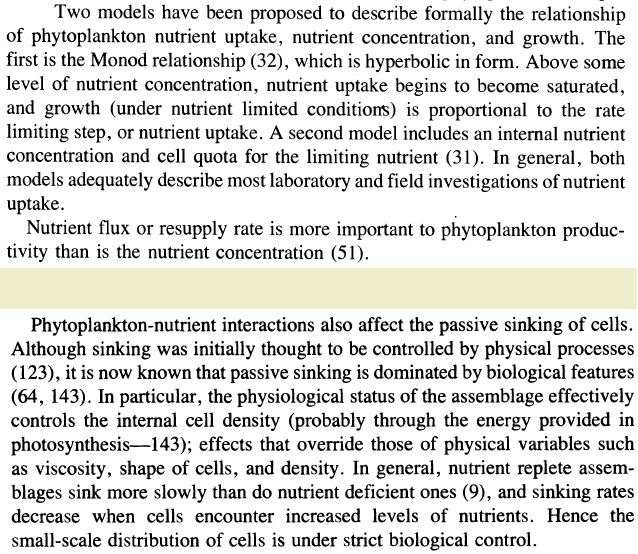
Nutrient uptake and phytoplankton

Monday, November 13, 2006

What can I infer from 'Results of Statistical Tests'?

Statistical results done on data throws up many patterns much like the data itself. It is getting interesting as I try and figure out

- which of the results are showing a pattern because of the pattern inherent in the statistical test. In my case, especially in SA by partial derivation method

- which are being shown because of extreme values present in the data set. In my case, especially when the point keeps moving between training, validating and testing data sets.

(and the most brilliant one)
- how much of it getting stuffed up because I am using the wrong scale to look the environment.