Terms that need to be defined, so that they are used in a consistent fashion; and in certain cases find the correct or more acceptable term.
1. Regression and terms related to regression
2. process based and data based models
3. filtering data, also called smoothing data?
4. Testing, Validating, Calibrating, Training!! (see yellow print outs)
Showing posts with label etc. Show all posts
Showing posts with label etc. Show all posts
Wednesday, December 17, 2008


Saturday, December 16, 2006

Saturday, December 09, 2006
On plagiarism
...just because a student gets the book on the works cited page, doesn’t mean the student hasn’t plagiarized. A misplaced comma, a forgotten quotation mark, a borrowed phrase, or image, is still plagiarism if it's not clear who the originator of the material is. It’s not intentional plagiarism. It’s not the kind of plagiarism that would get a kid kicked out of class, but it is the kind of plagiarism I have to talk to them about, make sure they are aware of it and fix it.
Quinn discussing plagiarism here.
Tuesday, November 28, 2006
Monday, November 27, 2006
dreams
have you ever felt that there is a dream just beyond your reach. that if your finger tips could just pinch at the fair cloth and then pull it to make your own - it would be yours forever. felt like your head is borosil bowl in which the ---- is just about to crystalise. and when that happens the entire scenario will change and there would be a rock to clasp in your hand, and feel its rugged surface gently in your palm. that your mind like iron pieces is scattered and there is a magnet just beyond that threshold and would it tip but slightly here...
i find population biology like that. an understanding that is just beyond me, that would that magnet tip but a little this science would be mine like the crystal in my hand. fair and clear. a dream waiting to declare that it is mine; and as the crystal leaves all that is impure in the liquid behind, purest of all - my dream.
i find population biology like that. an understanding that is just beyond me, that would that magnet tip but a little this science would be mine like the crystal in my hand. fair and clear. a dream waiting to declare that it is mine; and as the crystal leaves all that is impure in the liquid behind, purest of all - my dream.
Thursday, November 09, 2006
How this blog is organised
The point of this blog has been already explained in the Blog description. I will not cover that section again, I will instead, explain how this blog and labels are going to be organised.
Firstly, there is classification based on major research areas that i would be covering

* Understanding interactions within the population, i.e., if we only look at population vs time graph
* Understanding interactions of the population with its environment, i.e., if we look at chemical, physical and other population changes in the surroundings of population of our interest.
This section would cover discovering patterns in the time series, including periodicity and then moving to prediction. Hows "Patterns, Periodicity and Prediction in Phytoplankton Population Ecology" for a review article?
Secondly, there is classification based on the blog post made.
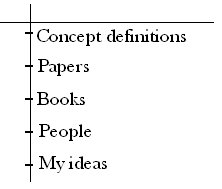
The definition section includes all quotes, excerpts and definitions. The rest of the diagram is self explanatory.
Final point in this post is about labels -
Labels: Each blog entry will therefore have labels based on the above categorisation. If it is a definition, the keyword would also be a label.
Friday, October 13, 2006
Research Interests
Since I am looking for a job, I would like to work, or rather continue working but at a larger scale in the area that I am already working in, Population ecology.
I am looking at the population dynamics of phytoplankton in an estuary in Victoria, using bio-physical time series. I have tried to understand the short time scale dynamics, varying from the order of hours to days. I have used an iterative non-linear statistical modelling tool which in other words is called feed-forward neural network. (neural networks have been given the bad name of being a black box, however I think it has got more to do with they way they are used).
Using partial-derivative sensitivity analysis (I have come across at least one paper which gets upset with this terminology) I have tried to evaluate the strength of the relation between each of the bio-physical parameter and chlorophyll. (chlorophyll is used an indicator of phytoplankton population.) And to see how the relationships change as the time interval between chlorophyll and bio-physical parameters is increased.
Now what I would like to do further is
- Study non-linear time-series and see how does chaos (which appears in weather time series and water flows) appear in ecological time-series.
- Study oceanography, my approach to my project was as a mathematician. I have, hopefully, learned some decent amount of biology in the process. However, I am sure there are quite a few things out there – so, I would like to do a short course in oceanography. (Note: I did NOT say I wanted to do a short course in chaotic time series analysis)
- Study Bayesian: Bayesian is used to quantify uncertainty. It is being used to make ecological models more accessible to decision makers who can use them as decision support systems.
Subscribe to:
Posts (Atom)

